Light Guide Validation Cell
Optical Validation, Machine Vision and Laser Marking

Reference Tech Specs
Dimmensions
(in mm)
3865 (L) x 4201,5 (W) x 2350 (H)
Weight
3500 kg
Voltage
Frequency
Main Fuse
Power Consumption
400 VAC
50/60 Hz
25A
15KW
Maximum Pressure
6 bar
For additional information, please contact Controlar at info@pt.controlar.com
Overview
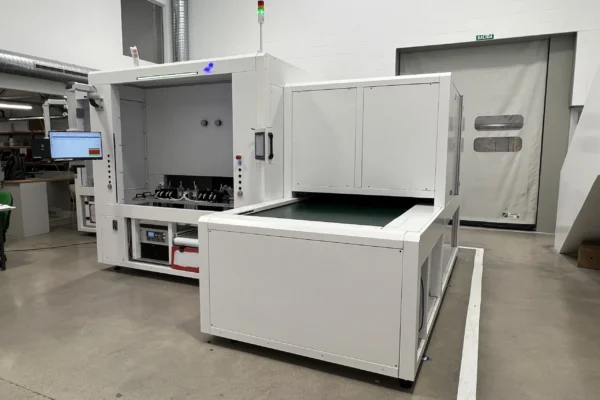
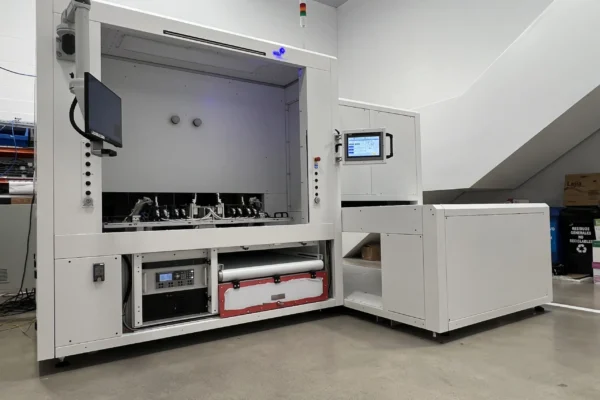
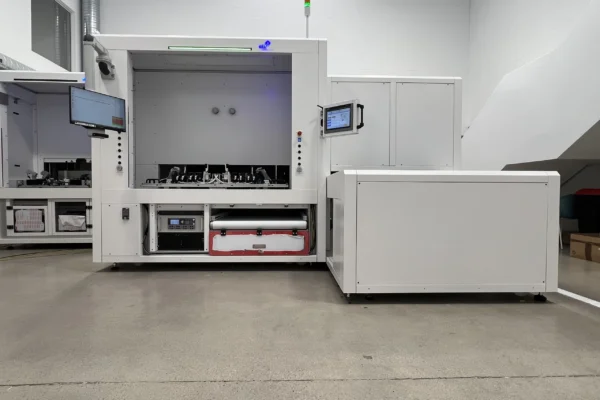
Our Light Guide Validation Cell is a semi-automatic end-of-line solution designed for the validation, inspection and traceability of light guides in the automotive sector. The system integrates optical performance validation, high-precision machine vision inspection and laser marking into a single cell, providing a complete quality control process in one station.
The solution was developed for demanding production environments where process repeatability, test condition stability and variability reduction are critical factors. The cell creates a controlled dark-chamber inspection environment, enabling the optical behaviour of each part to be assessed under constant and reproducible conditions.
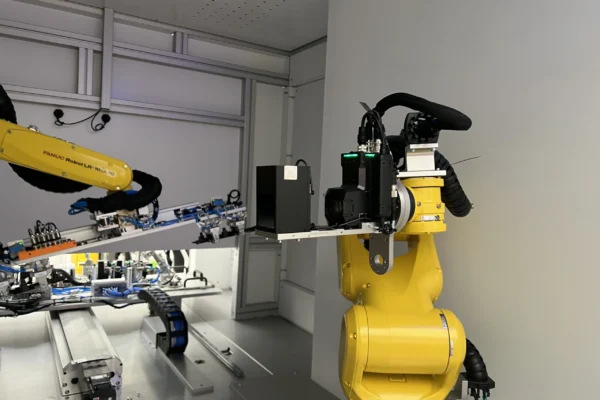
By integrating optical testing technologies, vision systems, robotics and traceability, the Light Guide Validation Cell provides a robust and flexible solution to ensure final product quality. The system optimises the production flow, reduces manual intervention and guarantees full traceability of each validated component.
Product Configuration
The Light Guide Validation Cell operates through a sequential semi-automatic cycle, combining manual part loading with full automation of the critical inspection, handling and marking operations.
The process begins with the operator placing the light guide in a specific fixture, designed to ensure precise and repeatable positioning. The assembly is then introduced into the cell, where a dark-chamber environment is created to allow optical validation under controlled conditions.
Once positioned, the part undergoes an optical performance test, in which parameters such as light intensity, homogeneity and colour consistency are assessed. Based on the result, the system automatically classifies the part as OK or NOK. NOK parts are returned to the operator for immediate removal, while OK parts automatically continue through the process flow.
Parts validated as OK are transferred by a robotic system to the machine vision inspection station, where the correct geometry and assembly of connectors and pins are verified.
The part then moves to the laser marking station, where permanent component identification is applied, ensuring individual traceability.
Finally, the system automatically separates the parts into two distinct outputs, one for conforming parts and another for rejected parts, ensuring clear management of the production flow and inspection results.
Main Applications
This system was designed for the validation of optical components in the automotive sector, particularly in end-of-line processes where rigorous and repeatable quality control is required. It is suitable for the inspection of light guides in interior and exterior vehicle lighting systems, as well as for components requiring lighting homogeneity and the correct integration of optical elements into more complex subassemblies.
Its flexible architecture makes it especially useful in high-volume production lines, where individual traceability, process stability and adaptation to different product variants within the same manufacturing system are required.